Showing posts with label Zombie Logic Press. Show all posts

Friday, August 28, 2026

Hike You!: The Bicycle That Came Out of the River


Hike You!: The Bicycle That Came Out of the River

Some objects become symbols because somebody deliberately makes them symbols. Others just show up.

This bicycle came out of the Rock River.

Mud-covered bicycle pulled from the Rock River stands in front of the former Rockford Register Star building, photographed by Ryan Davis for Hike You!


By the time Ryan Davis photographed it, it was standing in front of the old Rockford Register Star building, looking less like a bicycle somebody might ride than something the river had made. Mud coated the frame. Rust had gotten into it. Whatever ordinary life it had once possessed was over. Someone had pulled it from the water and propped it upright, and there it stood: wrecked, filthy, strangely dignified.

We kept seeing things like this because we kept walking.

That is where Hike You! came from. Ryan and I spent years walking Rockford together, often covering the same streets and paths again and again. The exhibition is about what happened when repetition stopped making those places more familiar and instead made them increasingly strange: two people taking “the same steps in the same town” until ordinary Rockford became “new and mysterious... and magical.”

It wasn't conceived as a documentary project. We weren't compiling an inventory of Rockford landmarks or trying to photograph the city's most photogenic places. We walked. Ryan carried a camera. I carried whatever it is a poet carries around in his head. Things presented themselves.

A rock. A discarded vacuum cleaner. An old theater marquee. Something dragged from the bottom of the river. The eventual subjects of Hike You! could be beautiful, ridiculous, damaged, historic, nearly invisible or all of those things at once. Even magnet fishing at Fordham Dam became part of the vocabulary of the project: “dragging rock bottom / we reel in rusty remnants / of the Screw City.”

The bicycle was different.

By then, both Ryan and I were in motion ourselves.

We had previous lives behind us. Versions of ourselves, expectations, habits, destinations. Neither of us was simply walking around Rockford for exercise. Without necessarily announcing it to ourselves at the time, we were walking into new lives. The walks became part of that transition. So did the photographs. So did the poems.

And there, outside the Register Star, was this bicycle that had literally been pulled up from beneath the surface of the city.

It had been somewhere else.

Now it was here.

That was hard to miss.

The haiku that emerged from the photograph was:

a little mud in my
gears won't make me forget my
heart is the motor

I like that the poem doesn't pretend the mud isn't there.

There is mud in the gears. Of course there is.

Transformation is frequently described as though the old life simply falls away and the new one begins cleanly. That wasn't what this bicycle suggested to me, and it wasn't what our lives looked like. You bring things with you. Some damage remains. The gears grind. The frame shows where it has been.

But the heart is still the motor.

The bicycle became one of the pieces that most clearly expressed something I gradually understood about the larger Hike You! project. We thought we were repeatedly walking through Rockford, but Rockford was also providing us with a language for understanding what was happening to us.

The city was full of metaphors we hadn't asked for.

That mattered particularly in this location. Behind the bicycle stands the former Rockford Register Star building, itself a monument to a Rockford that was already changing. In front of it is an object recovered from the Rock River. And somewhere between the old newspaper building, the river mud, the rusted bicycle, Ryan's photograph and my seventeen syllables were two people trying to figure out what came next.

There was no reason to know, when we started walking, that any of this would become an exhibition.

That is one of the things I love most about Hike You!

It emerged.

A walk became another walk. A photograph became a poem. Familiar streets became unfamiliar. Things we'd passed dozens of times suddenly demanded attention. Eventually we had accumulated evidence of something neither of us had quite intended to make.

The project's subjects can appear almost comically insignificant. That's part of its philosophy. The Times Theatre doesn't need a magnificent restored marquee to become worthy of attention; its modest one can resemble “the proud grin of a third child / missing their first tooth.” A dirty bicycle doesn't have to be repaired, polished and returned to the road before it can tell you something about continuing.

Sometimes you get dragged out of the river covered in mud.

Sometimes somebody stands you back up.

And sometimes that is enough to begin again.

Hike You!
Thomas L. Vaultonburg + Ryan Davis
Fall ArtScene 2026 — Rockford, Illinois

Saturday, August 8, 2026

Review of Vanished Roads By Conrad Sienkiewicz

 Review of Vanished Roads By Conrad Sienkiewicz

“Vanished Roads” by Thomas L. Vaultonburg is a fantastic collection of just over 100 haiku. Many are in the traditional format of 5-7-5, yet those with fewer syllables really show off Vaultonburg’s skill in doing more with less. Some of his haiku have only four words, yet the mark they make upon the reader is palpable. What Vaultonburg can do with merely four words is impressive and enviable!

Cover of Vanished Roads by Thomas L. Vaultonburg
Buy Vanished Roads From Wolf Twin Books

Some haiku in this collection are humorous, while others are more somber and reflective. All show a keen eye for nature and an appreciation of life in all forms.

Through his poetry and his fine skill with words, Vaultonburg gives us a magical world, where hats become pilgrims, coyotes deliver sermons, furniture grows teeth, and buckets carry stars.

Vaultonburg’s best efforts can comfortably rest alongside those of other haiku masters, such as Basho and Issa. His haiku “ripe figs” recalls William Carlos Williams’ icebox plums.

Read altogether, the poems feel like a hike through the woods, with occasional stops in more civilized environs. The simple illustrations by Tré that pepper the book complement some of the poems without distracting us from the words.

Illustration from Vanished Roads by Tré.
Illustration "The Mountain Path" by Tré from page 81 of Vanished Roads.


You can also read Conrad's review at Goodreads


Thursday, July 23, 2026

Review of Vanished Roads By Melanie Medved

 Review of Vanished Roads By Melanie Medved

Buy 

I thought Thomas L. Vaultonburg's new collection of poems was going to stay with me for an afternoon, which is how long it took me to devour his latest publication, “Vanished Roads.” Instead, it's been lingering for two weeks now, in the way the first Autumn night air settles into your bones. It’s just sitting there, thick with emotional residue and meaning, while I struggle to succinctly put into words just how stellar the collection is.

Vaultonburg has been a favorite of mine for years. Following his literary career through everything from darker poetry to children's books and fiction, I've witnessed him move effortlessly between genres and forms. He has a strong ability to shapeshift as a writer, yet maintain his track record of consistent excellence in all genres. I was looking forward to his collection of haiku/short-form poetry, waiting to see if he could once again knock it out of the park. He has.

From the opening poem, which arrives not like a leaf drifting onto the page, but like a train waking you up in the night, Vaultonburg announces his poetic intention immediately— You’re going to feel something as you read these poems. The first three lines introduce a pattern he will use often throughout the book— most often staying true to the concept of traditional haiku using a central subject in nature (in this case, wind and bamboo) and adding a few perfectly chosen words to assign it an emotional impact (this time, human emotional frailty and ennui) that often jumps out at the reader with layers of meaning. He writes:

wind through bamboo

I too

Am hollow.

Then, after announcing himself and his arrival, without hesitation, he rolls up his sleeves and trudges off in old boots into the colorful territory: dawn, peonies, the evening rain, deer, wolf tracks and more. Quietly threading the beautiful natural landscapes we all encounter each day, with the fragile emotional territory of grief, regret, loneliness, and hope— one after the other, painting them together in a style that is somehow both bold and vivid and soft and gentle at the same time— Vaultonburg is like the Van Gogh of poetry.

Though his subjects are universally relatable, they are still deeply personal, as evident early on pages 8 and 9, when he writes about the passing of two family members in a way that made me ache with empathy and understanding. Those feelings accumulate with each page, and nearly every haiku hits hard. By the final page you’re sitting there with the wind knocked out of you, not by a hurricane, but by a light spring rain. The weight of his tiny gray book is difficult to shake, in the best possible ways.

A bonus is that it felt like a two-in-one book: poetry combined with Buddhist wisdom. Many writers try hard to “teach” lessons, and while Vaultonburg wasn’t even trying, he landed quite a few with ease:

bee in the window

I open it

for both of us

(page 30)

He has a subtle yet strong way of showing how our lives intersect with the natural world, and the impact each can have on the other. He saves a bee, and in doing so, he’s sparing a small piece of himself. Those everyday sadnesses of trapped bees lie in juxtaposition with hope and happiness on the pages. “Wheat fields ablaze with joy” and prairie winds that steal hats are felt just as strongly through his curated words. He writes of dharma and dragonflies opposite a page which encourages the reader to:


Ask the snow

to forgive you—

then leave no trail

Last but not least, another highlight are the illustrations by his writing partner Tré, whose tiny pen-and-ink style drawings show up at just the right time and place to add another beautiful layer to the already outstanding book. The two have proven they are a powerhouse before in their combined haiku/illustration book, “Moonscape,” and it is just as magical to see little glimpses of her art show up here in his solo volume.

In summary, this is truly some of the most recent memorable poetry I’ve experienced in years. After closing this book, I felt like I’d discovered something for the first time. My mind went back to third grade when I first read Carl Sandburg’s poem “Fog.” 40 years and thousands of poems later, it’s hard to recapture the joy that I felt in that classroom of my first favorite poem, and yet, Thomas Vaultonburg has handed me that joy again with “Vanished Roads.” His strict inventory of words, ability to capture single snapshots in time, and his ability to produce a book this wise without a single trace of pretention should be embraced and applauded by old and new fans of poetry alike.


Tuesday, April 30, 2019

Paper Fingers Zine on the Last Day of Poetry Month

We created a PDF file for the Paper Fingers Zine we created at the Paper Fingers event at 317 Collective in March. You can delve into the whole project at www.paperfingers.com It contains the work Rockford area writers David Pedersen, Micky Torpedo, Richard Vargas, Tim Stotz, Travis Legge, Dylan Garcia,  Erica Toldeo, Sky Garcia, Thomas L. Vaultonburg, Christopher Simms, Sharon Nesbit-Davis, Dannie Mathews, and many others. The art department/ilustrators include Joe Tallman, Sarah Reed McNamara, Jenny Mathews, Lucian Kuranz, Taylor Hopkins, Asa E Burnley, Jack Mathews, FoodStamp Davis, with photography by James Hogan, Jenny Mathews, and Ryan Burritt.

Paper Fingers poster by Rockford artist Joe Tallman


It's really rewarding when a project is received well. We sold out the print run of Paper Fingers at Art Scene. And had one helluva time with our cohorts at 317 Art Collective to boot. Thank you so much to everyone who collaborated with us to make this happen. We'll definitely be doing another zine soon.

Thomas L. Vaultonburg is a poet, haikuist, editor, and publisher from Rockford, Illinois. He is the founder and editor of Zombie Logic Press and Zombie Logic Review and co-founder, with artist Tré, of Wolf Twin Books. His work ranges from haiku and short-form nature poetry to absurdist, comic, and surreal poems rooted in the strange details of everyday life.

Vaultonburg is the author of numerous collections, including Vanished Roads, Small Songs for Weary Travelers, Moonscape: Haiku Phase I, Flesh Wounds, Submerged Structure, and Atrocious Poems A to Z. His recent work increasingly explores the landscapes, wildlife, streets, abandoned places, and overlooked corners of northern Illinois.

A longtime admirer of Richard Brautigan, Vaultonburg has often been drawn to poetry that can be funny without surrendering its strangeness: brief poems, unlikely metaphors, conversational language, and jokes that open onto something slightly larger than the joke. “The Yellow River” comes from that side of his work—a small comic poem in which the inflated language of warfare collides with the considerably less heroic realities of the human body.

Vaultonburg has also participated in Rockford's long-running experiments in bringing writing out of books and into public spaces. In March 2019, his work was connected with the Paper Fingers: Mechanical Typewriting in the Digital Age exhibition at 317 Art Collective in Rockford. Curated and hosted by David W. Pedersen, the two-day exhibition combined a type-in, creative-writing experiment, social experiment, historical exploration, and art exhibition. More than fifteen mechanical typewriters were displayed, with visitors invited to sit down and use the machines themselves.

That emphasis on writing as something physical, communal, and slightly unpredictable anticipates much of Vaultonburg's later work in Rockford—poetry appearing not only in books and literary journals but in bookstores, galleries, public-art installations, collaborative exhibitions, and on the streets themselves. Projects such as Hike You!, SECOND NATURE, and his collaborations with Tré continue the same basic impulse: take the poem off the page, put it somewhere unexpected, and see what happens when somebody encounters it.


Wednesday, May 16, 2018

Book Book Book

I try not to use Zombie Logic Review to promote myself, Zombie Logic Press, or anything else I might be working on too often, but once in a while I just need a few extra sheckles in the coffer to work on my next project(s). This is one of those times. Sort of like a pledge drive. Let me pitch you two of my books.


Flesh Wounds is a book I wrote during my time in the service industry. The title reflects the toll working in that industry can take on one if you fall into the many pitfalls and temptations present, which I invariably did. If I may say so I really enjoy the cover I designed of me standing in for the apostle Thomas holding a can of Schlitz examining the wounds of Jesus.

I'm told this is probably the best poem I wrote for that book, and it's only saving virtue.

 Pinata 

 You were our first lesson 
 In rage and greed- 
 Possibly love. 
 Our smiling guardian 
 Put the stick 
 In our small hands, 
 Blindfolded us 
 And whispered that 
 Unspeakable treasures 
 Awaited us when we 
 Destroyed you. 
 Spun around and 
 Drunken with images 
 Of unimaginable trinkets 
 We became whirling dervishes 
 Of lust and anger, 
 Whacking and thumping away 
 At your broken smile 
 Way past nap time, 
 Until frustrated with 
 Our lack of killer instinct, 
 Our teacher sawed you 
 In half, spilling 
 Far less enticing bounty 
 Than we had dreamed of. 
 Some rushed forward and 
 Grabbed and devoured, 
 Others stood back and 
 Cried over the carnage. 
 Either way we all learned 
 Who we would be that day. 

You can buy Flesh Wounds here


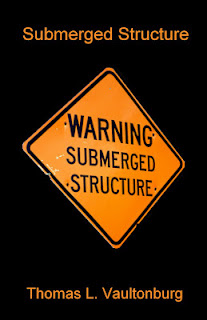
Submerged Structure is a book I wrote that deals with suffering from a personality disorder but still having the desire to communicate and be present with other people. It's a struggle for many of us. 

Away Message 

I am away 
From my desk 
Right now 

I am away 
From the gravity 
Of lover's 
Embrace 

I am away 
From the vessel 
Right now in 
A geosynchronous orbit 
Around the lost moon 
Of Jupiter 

So leave me 
A message 

Because I 
Am away. 

You can buy Submerged Structure here 

Any spreading of the word is much appreciated. I'd like to keep doing this a little longer.


Tuesday, June 20, 2017

F Is For Failure From Atrocious Poems A To Z

Failure is the last poem I finished for Atrocious Poems A To Z, and I got it finished mere days before the deadline we had set for ourselves. The poem itself had certain prerequisites because it had to contain and have explainable paradoxes in it to comply with the standard I was trying to adhere to that the poems needed to have something teachable about them. All except dog poop and urination, of course. 

Taking the lazy way out, I of course tried to retrofit a poem about failure I had written at Jack's Cub Scout meeting a couple of weeks previous, but Jenny wasn't buying it, so she looked up a list of paradoxes and saw a quote by George Carlin which she incorporated into the poem. I wanted to quote the line from George Carlin and use it as an example of paradox, but was overruled. 


Illustration by Jenny Mathews poem by Thomas L. Vaultonburg
This is the only place on the internet I'll post F. Then I think I'll alternate the rest of the letters I haven't done among the other blogs I edit or use as personal blogs.

The book is finished and for sale at Amazon, as well as the gift shop of the Rockford Art Museum. It's also on the walls of the Rockford Art Museum in its entirety as part of an exhibit titled Bittersweet Observations. The rest of the family is on vacation in Rhinelander, and I'm sitting here drinking sparkly water and eating grapes. 

I have decided I will only use the Times font forever after in all my writings. 

If anyone reading this is willing to write a review on Amazon I'll send you the PDF of the book. Just let me know, poets of America. One way you can really help me out.


Monday, May 9, 2016

Todd Moore, The Founding Force of Outlaw Poetry, and Dennis Gulling's The Blood Dark Sea

Most people don't know this, even people sort of well-versed in the history of the small press, but Outlaw Poetry was started right here in the Rockford area. Belvidere to be exact. By an English teacher at Belvidere High School named Todd Moore. I read with Todd Moore several times, including one time in a basement in Stillman Valley with another legendary small press poet, Lyn Lifshin. he is one of the few poets I ever sent a fan letter to, and my geographical proximity had nothing to do with that. He was a revered small press poet, and probably had a better chance being recognized in Los Angeles than here in Rockford. Like virtually every small press poet I wrote to, including Charles Bukowski, he turned out to be friendly, encouraging, and took time to answer my questions about what it meant to be a small press poet.

Todd Moore Dillinger

Dillinger by Todd Moore


he made an impression on a great many prospective writers, including one of his students, Dennis Gulling. So much so that Dennis became a sort of protege of Todd Moore, and began writing his own impressive Outlaw Poetry during high school. For nearly thirty years he has been quietly compiling some of the most impactful poetry of anyone writing in the Midwest. Because of his reclusive nature this has gone unnoticed to many. But those who know speak the name of Dennis Gulling with a respect and appreciation for his canon of work.

Now, for the first time, his poetry has been collected into a full-length book of poems, The Blood Dark Sea. The selections were made by Dennis Gulling himself, and compiled and published by Zombie Logic Press, also of Rockford, Illinois. I am, in fact, the editor of that book, Thomas L. Vaultonburg, and I can report the more I read these poems, and I believe I may have read them more than anyone else on Earth, besides Dennis Gulling, the more I am convinced this is a tour de force of not only Outlaw Poetry, but poetry itself. 

I start out this sequential set of poems from The Blood Dark Sea with the poet's own ode to his mentor, Todd Moore. 

SOMETHING FOR TODD

The words poured off him like water
Through a broken dam
I was sucked
Into the flood
Clear and cold
Held under by its weight
And I’ve been
Drowning ever since
Diving deeper
Into the darkness


HOW I LOST $10

Bill Quincer banged on
My back door with a towel
Wrapped around one hand
Said he’d cut off
A finger with his band saw
And wanted me to drive
Him to the hospital
On the way over
He took a bloody handkerchief
From his shirt pocket
Held up the finger
And said
What’ll you give me
If I walk into the emergency room
With this thing up my nose?


 TRENCH COAT

The guy in the trench coat
Paced back and forth
Outside Goodman’s Cafeteria
With his hands pushed
Deep in his pockets
Putting his face to the window
Every few minutes
Until he fell back suddenly
Into the shadows
As a guy in a leather jacket
Came out the door and started
Down the street
Trench coat stepped out
Of the darkness
And said a man’s name to his back
Leather jacket turned around
And his eyes got big
He made a run for it
While a pointy bulge
Appeared in trench coat’s right pocket
Something popped
And leather jacket was pasted
To the air just for a second
Then he started walking
Like the sidewalk had melted
Did that for a few yards
Then stopped in his tracks
In front of Greenberg’s Variety
His legs jackknifed at the knees
And he went over sideways
Between 2 parked cars
Trench coat’s giggle
Was broken glass in the night
He danced a little jig
Then walked the other way


SHE SHOT HIM

She shot him
In the head 3 times
Then chopped his fingers off
With a hatchet
And put them in her purse
Beside chewing gum
Kotex and keys
Later
At the Hoot ‘n’ Holler Café
She dropped a thumb
In an ashtray
Next to a smoking butt
And laughed
All the way out the door


EVIL

A voice in his head
Told him his index finger
Was evil
So he took a ginsu knife
And cut it off
Then he left the house
Until the evil could
Run out the open end
His wife came home
From the grocery store
And dropped her bag of stuff
When she saw all the blood
On the kitchen counter
Then noticed the finger
On the floor pointing toward
The front door like it was saying
He went that-a-way


Wednesday, November 26, 2014

Unique Christmas Gift Ideas From Zombie Logic Press

Unique Christmas Gift Ideas From Zombie Logic Press

The best Christmas gifts are not always the ones stacked highest in the big-box stores. For readers, poets, collectors, and people with a taste for the strange, an independently published book can feel genuinely personal. Zombie Logic Press offers poetry from outside the literary mainstream: funny, unsettling, candid, and proudly rooted in the small-press tradition.

A Christmas Story


Founded by Rockford poet Thomas L. Vaultonburg in 1997, Zombie Logic Press has spent decades publishing work that might not fit neatly on a conventional bookstore shelf. Every book in the online catalog is available directly from the publisher, making these uncommon volumes especially good gifts for readers who value independent literature and books with histories of their own.

For the Reader Who Likes Poetry With Teeth

Atrocious Poems A To Z


Atrocious Poems A to Z is an excellent choice for someone who prefers irreverence to solemnity. The collection moves alphabetically through absurdity, satire, bad behavior, and the darker corners of contemporary life. It is a poetry book for the person who claims not to like poetry—or who wishes more poets would stop behaving themselves.

For the Small-Press Poetry Collector

Detached Retinas by Thomas L. Vaultonburg


Originally published in 1997, Detached Retinas belongs to the early history of Zombie Logic Press and Thomas L. Vaultonburg’s work. It makes an unusual gift for collectors of underground poetry, independent publishing, and literary artifacts from outside the institutional mainstream. Rather than offering something mass-produced and interchangeable, it gives the recipient a piece of genuine small-press history.

For Someone Drawn to Dark, Unflinching Poems

Flesh Wounds by Thomas L. Vaultonburg


Flesh Wounds gathers poems concerned with the body, damage, survival, alienation, and the peculiar comedy that sometimes accompanies difficult experience. This is not decorative poetry meant to sit harmlessly on a coffee table. It is a gift for a reader who appreciates direct language, uncomfortable honesty, and work willing to enter less polite territory.

For the Reader Who Prefers Depth to Reassurance

Submerged Structure by Thomas L. Vaultonburg


Submerged Structure explores what remains beneath the visible surface of a life: memory, identity, illness, estrangement, and the patterns we recognize only after years have passed. It would suit a thoughtful reader interested in personal poetry that resists easy inspiration and instead looks closely at how people endure, adapt, and continue.

Give Something That Will Not Be in Every Other Package

A book from an independent press carries a different kind of meaning. It supports the continued existence of work created beyond corporate publishing, helps preserve small-press literary history, and places an unexpected book into the hands of someone who might never otherwise encounter it.

Visit www.zombielogicpress.com to explore the complete catalog and find a Christmas gift for the poet, outsider, collector, contrarian, or beautifully peculiar reader in your life.

Saturday, December 1, 2012

Submitted To the Academy For Your Approval


For the entire month of December I'll be featuring my own poetry here at Zombie Logic Review. This poem appears in my book Flesh Wounds. Submitted to the Academy for your approval...


Poet Thomas L. Vaultonburg


   Acceptance Speech

   I'd like to thank the Academy
   For not giving me this award
   Or the cash prize that goes
   With it. I'm convinced
   Another year of anonymity
   And privation will do
   Wonders for my work.

   I'd like to thank God
   And my father
   For being the same guy:
   Perfect at work,
   Useless everywhere else.

   I'd like to thank my country
   For teaching me to kill
   Those who needed it
   And defend those who
   Deserved it and the ignorance
   Not to know the difference.

   I'd like to thank the women
   Of America for choosing
   More obvious choices for their
   Recreational and breeding needs.
   Your daughters are coming
   Along fine. 

   Most of all I'd like to thank
   You for taking 98 seconds
   Out of your busy schedule
   To not enjoy this poem.